
Spider veins are one of the most common vein changes people notice — but what you can see on the surface often reflects what’s happening deeper in the vein system.
If you’ve been wondering what the real reason for spider veins developing is, the answer usually lies beneath the skin. Understanding the underlying cause can help you make more informed decisions about your vein health and whether a professional assessment is worthwhile.
The most common reason for spider veins is venous dysfunction.
Healthy veins rely on one-way valves to keep blood moving back toward the heart. When these valves weaken or stop working properly, blood can begin to flow backwards and pool in the vein. Over time, this increased pressure causes veins to stretch and become visible.
This process, known as vein valve dysfunction, is the underlying cause of both spider veins and varicose veins.
Cause | What’s happening in the vein | What it leads to |
Genetics | Weaker vein walls or valves | Higher likelihood of visible veins |
Pregnancy and hormones | Increased blood volume and pressure | Veins enlarge and become more noticeable |
Prolonged sitting and standing | Reduced circulation and blood pooling | Increased pressure in leg veins |
Ageing | Loss of elasticity in vein walls | Veins stretch and become visible |
Lifestyle factors | Increased strain on the vein system | Progression of vein dysfunction |
Spider veins appear when small veins near the surface of the skin become enlarged due to increased pressure.
As blood pools in these veins, they become more visible, forming the fine red, blue or purple lines commonly seen on the legs or face.
In simple terms, veins become visible when they are no longer circulating blood efficiently.
Spider veins and varicose veins share the same underlying cause, but they present differently.
Feature | Spider Veins | Varicose veins |
Size | Small, fine vessels | Larger, bulging veins |
Location | Close to skin surface | Deeper under the skin |
Appearance | Red, blue, or purple web-like lines | Twisted, rope-like veins |
Cause | Early vein valve dysfunction | More advanced venous insufficiency |
Symptoms | Often minimal | May include aching, swelling, heaviness |
Because they share the same root cause, spider veins can sometimes be an early sign of vein disease.
Not everyone with spider veins experiences symptoms, but early changes in vein function can include aching or heaviness in the legs, mild swelling, itching or irritation, and restless legs particularly at night.
If any of these sound familiar, or if you have a family history of vein disease or notice your spider veins are increasing, it may be worth having your veins professionally assessed.
Spider veins don’t always indicate a serious condition but they can suggest that your veins are under increased pressure.
The key is understanding whether they are isolated surface veins, or part of a broader pattern of venous dysfunction
A duplex ultrasound is the standard first step in assessing vein health. Unlike a surface-level examination, it provides a detailed picture of blood flow and valve function — revealing whether spider veins are isolated to the surface or connected to deeper venous dysfunction. This is what allows treatment to be guided by what’s actually happening in the vein system, not just what’s visible on the skin.
If treatment is recommended, the focus is on addressing both visible veins and any underlying cause.
Depending on your needs, options may include:
These modern, minimally invasive approaches are designed to support healthy circulation and manage vein dysfunction.
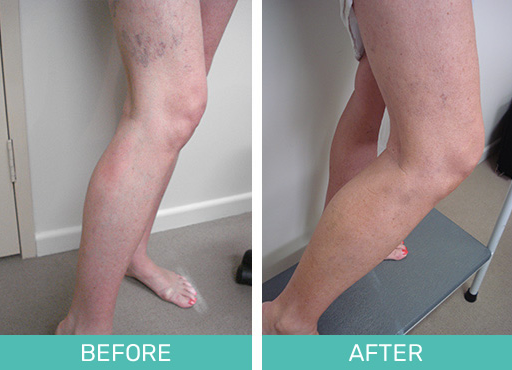
Treatment used: Ultrasound guided sclerotherapy (UGS) and microsclerotherapy
Disclaimer: These images demonstrate possible treatment outcomes but are not intended to represent typical results. Individual response to treatment varies and should be assessed on a case-by-case basis.
Common side effects include stinging, bruising, darkening of spider veins soon after treatment but fading over the next few weeks, aching legs immediently after treatment and phlebitis which can be improved with exercise and compression. A consent form that outlines the full list of risks and concerns will be provided by your doctor.
Spider veins are often more than a surface change — they can reflect how well your veins are functioning beneath the skin. Understanding what causes them, from genetics to lifestyle and hormonal changes, can help you recognise early signs of vein disease before they progress.
If you’ve noticed changes in your veins or want to know what they mean, the first step is a consultation with one of our vein doctors.
General Information PDF
Send our brochure directly to your Inbox.
Don’t worry, we won’t spam you. We will follow up in case you have any more questions.
"*" indicates required fields
10 Questions
To Ask Your Vein Doctor
Send our brochure directly to your Inbox.
Don’t worry, we won’t spam you. We will follow up in case you have any more questions.
"*" indicates required fields
Vein Doctors Group prides itself on having a culture of collaboration & collegiality. Our medical director is proactive about sharing knowledge, sharing patients & driving other doctor’s business through cross referral and individual doctor promotion.
The strength of the group is only as strong as the strength of each individual doctor, and we aim to ensure each doctor feels supported and nurtured by Vein Doctors Group to cultivate a thriving career progression.
Explore collaboration opportunities with other trainees and Fellows to support your career progression and patient management pathway. Specialist Ultrasound Service – dedicated vascular sonographers working alongside Fellows and trainees providing pelvic scans, CVI & DVT studies, mapping for treatments, as well as providing reports for Medicare.